Dental treatment brands run on consistency. Patients expect a smooth visit, and your front desk expects clean payments that do not get stuck in rework. But even a “simple cleaning claim” can get denied when the code, age rules, frequency limits, or documentation do not match the payer’s policy.
One big reason this happens is that dental coding keeps changing. One industry source notes there were 160 CDT code changes in the last 3 years, which is a lot to track when your team is also handling scheduling, verifications, and daily production.
In this guide, you will learn what is dental code d1110, how to use it correctly in 2026, how to avoid common denial triggers, and what to document so your claim does not get pushed into delays.
Adult prophylaxis is the routine “preventive cleaning” most patients think of when they say, “I need my 6 month cleaning.”
In CDT code D1110, the goal is prevention. The cleaning removes plaque, calculus, and surface stains so irritation stays under control and gingival health stays stable.
This is different from periodontal services like scaling and root planing or periodontal maintenance, which are used when there is active periodontal disease or a history of periodontal treatment.
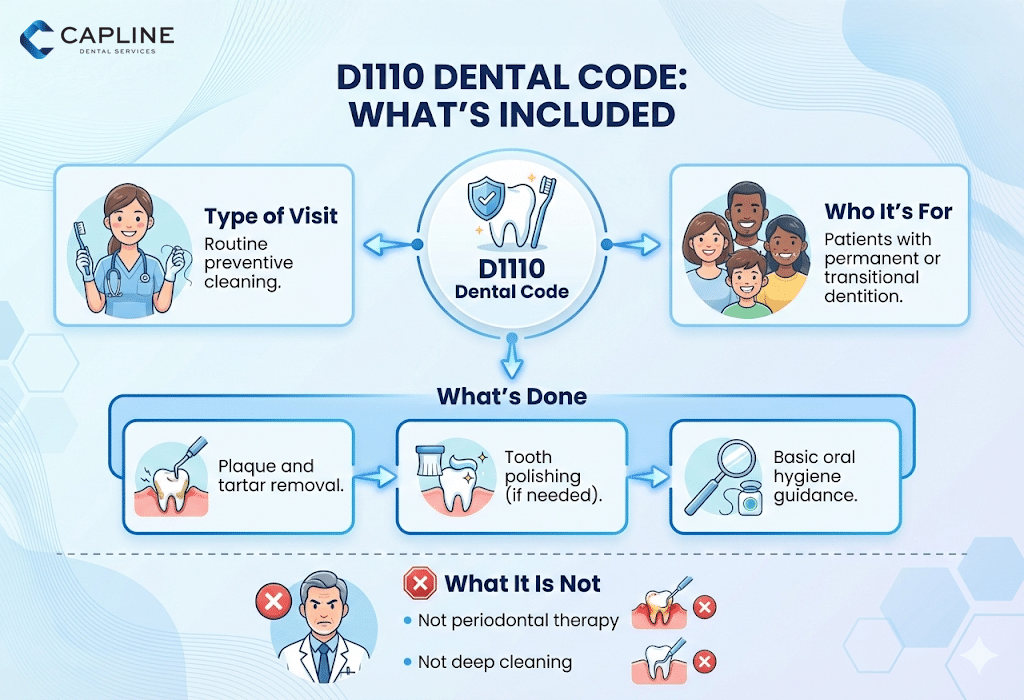
Let’s keep it simple. D1110 dental code description is basically a full mouth preventive cleaning for patients with permanent or transitional dentition.
In a normal visit billed as d1110 dental code, the clinical work often includes:
Some 2026 code references also connect the cleaning to tooth structures and implants, which matters when patients have implant crowns that need routine plaque removal too.
Important note: D1110 is not meant to describe a periodontal therapy visit. If the patient needs heavier therapeutic scaling due to inflammation or periodontal disease, another code is usually the correct match.
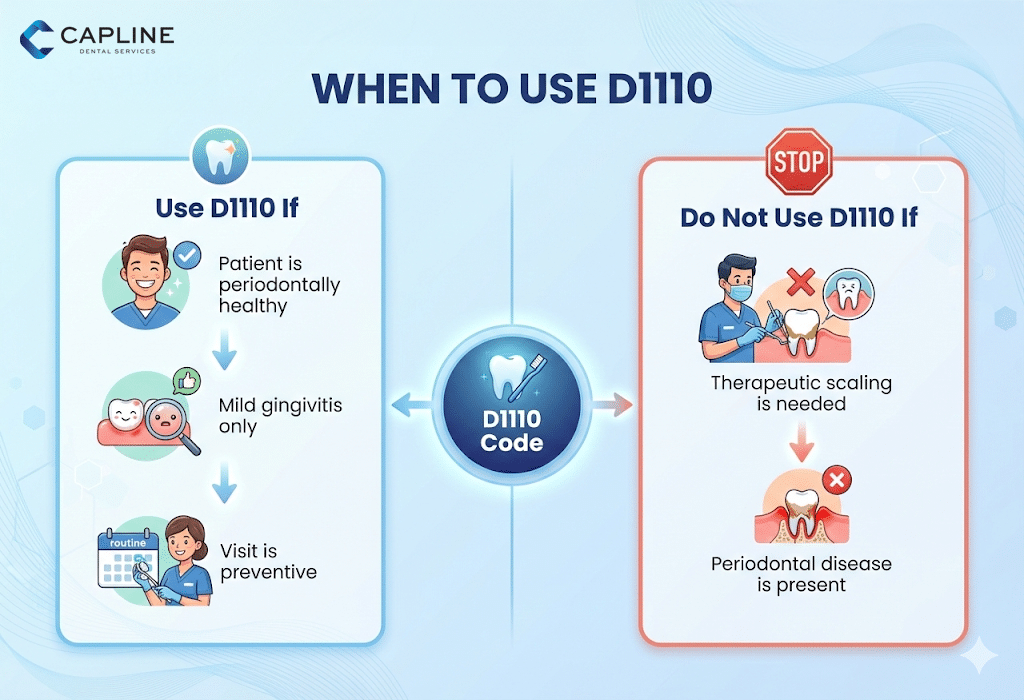
Use what is dental code d1110 when the patient is generally healthy from a periodontal standpoint, or they only have mild gingivitis and do not need periodontal therapy.
A simple way to think about it:
Many billing teams also get stuck on age. Clinically, the adult vs child difference is based on dentition, but payers may still apply age edits.
The ADA even shares an example where a payer tried to force a “child prophy code” based on age, even though D1110 was correct based on dentition.
So the real rule is this:
Use D1110 when the procedure matches the adult prophylaxis definition and your payer allows it for that member’s plan rules.
Here is a clean example you can picture in a real practice.
Patient: 28 year old recall patient
Chief concern: “Just here for my regular cleaning”
Medical history: No major risks
Periodontal findings:
Procedure performed:
Correct code: cdt code d1110 (Adult prophylaxis)
Why it works: The patient does not show periodontal disease that requires SRP or perio maintenance. This is a straightforward preventive visit.
This is the part that protects your revenue and keeps your schedule running clean.
Most plans limit routine prophylaxis to a set frequency. For example, one 2026 payer guide shows coverage commonly set as twice per calendar year with age guidance starting at 13 and older for D1110.
That means your claim can deny even when the code is correct, simply because the patient already used their covered cleanings.
If a patient has a history of periodontal treatment, many payers expect periodontal maintenance, not routine prophylaxis.
A common denial trigger is billing D1110 when the patient should be D4910, or billing D4910 when the payer says the patient never had perio therapy on record.
Some services become “components” of other procedures when done on the same date of service.
For example, the Delta Dental 2026 Dentist Handbook discusses how adult prophylaxis (D1110) can be considered a component when submitted the same day as scaling and root planing (D4341).
So if your provider performs SRP and you also submit D1110 on the same day, expect issues unless the payer policy and documentation allow it.
Even when clinical dentition supports D1110, payers may deny based on their internal age rules.
If the patient has generalized moderate to severe inflammation, and the provider performs full mouth scaling because a routine prophy is not enough, D1110 may not be the right code.
In many payer policies, D4346 becomes relevant in those situations.
Documentation is what protects you when the payer reviews the claim.
For a strong D1110 claim, chart notes should reflect:
D4910 exists for maintenance following periodontal therapy and can continue long term.
Some payer guidance discusses D4346 as a separate scenario that is not the same as a basic prophy.
ADA code D1110 is one of the most common preventive codes in dentistry, but it is also one of the easiest to get denied when the situation does not match the payer’s rules.
If you want clean claims and fewer delays, remember this:
Use d1110 dental code only when the visit is truly preventive, stay aware of payer frequency and age edits, do not stack it incorrectly with periodontal procedures, and document periodontal health clearly.
When your team gets D1110 right, you protect recall revenue, reduce rework, and keep your hygiene schedule profitable.
Need support training your team to reduce denials and keep billing clean across multiple locations?
Capline Dental Services can help you find experienced dental billing and admin talent that fits your workflow. Connect with us today.
Clinically, D1110 is tied to dentition, not a strict age rule. But many insurance plans still apply age edits. The ADA even highlights cases where a payer’s age message was wrong, and the correct code depended on dentition.
It varies by payer and plan. One 2026 CDT guide shows D1110 commonly aligned to age 13 and older, but you should always verify the patient’s specific benefits.
Many plans cover routine cleanings twice per year. A 2026 payer CDT guide shows “twice per calendar year” as a common structure.
Your notes should support a preventive cleaning, not ongoing perio care. Include periodontal findings (pockets, bleeding, tissue condition), lack of perio therapy history, and the preventive intent of the visit. If the patient has a documented history of periodontal therapy, D4910 may be expected instead.
Most plans cover two routine cleanings per year, but some plans cover more often when the patient qualifies under a special benefit design. Always confirm the plan rules during verification.