At some point, you must have encountered a situation where you were frustrated as the notification of the claim denied flashed on your screen.
You have treated the patient; he/she is happy, but the insurance company denies your claim due to a technicality in your records or billing. But why is there a mistake in your records? The reason can be incorrect dental codes
Whether you are treating bruxism, TMD, or protecting expensive restorative work, selecting the right code is the difference between a healthy revenue cycle and a mounting pile of uncollected debt. A single aspect can be more problematic on the administrative level than the night guard dental code and its related adjunctive services. So let’s discuss
Dental codes, formally known as CDT (Current Dental Terminology) codes, are a standardized set of alphanumeric identifiers used to document and bill dental procedures. These codes are decided by the American Dental Association (ADA), and they offer a universal language among providers, patients, and insurance payers.
Every procedure, a simple prophy as well as a complex full-mouth reconstruction, is assigned a five-digit code, beginning with the letter D. To give you an example, when you search a night guard dental code, you are finding your way through the Adjunctive General Services section of the CDT manual. These codes help in making sure that all those who are involved in the transaction know precisely what was conducted in clinical work.
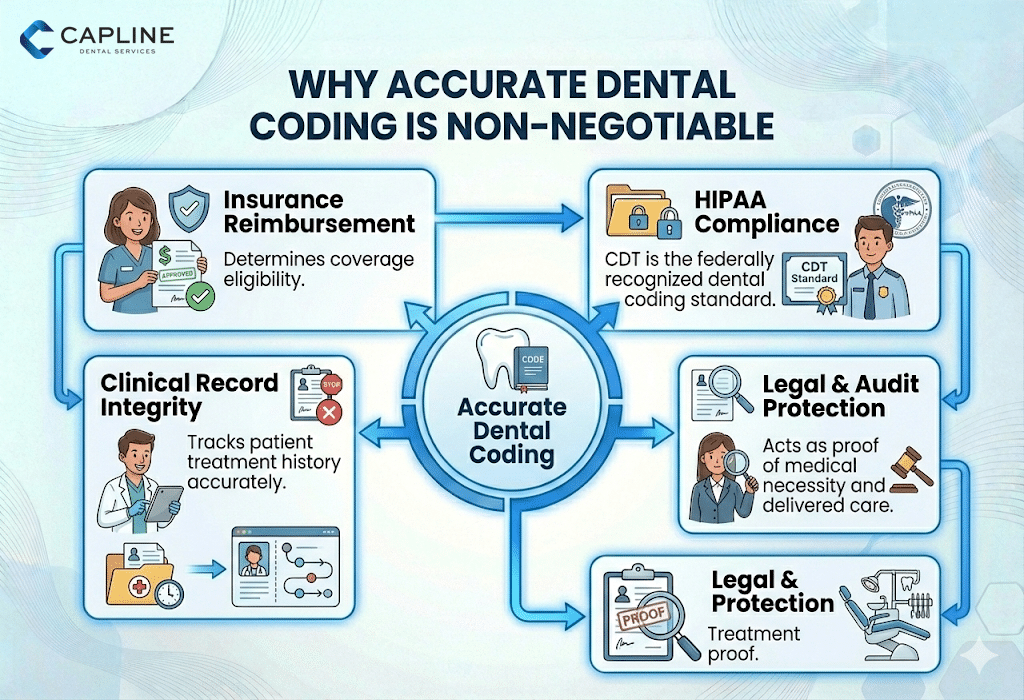
The current US healthcare system is based on standardization. In the absence of a standardized coding system, all the practices would define "occlusal guards" differently, which would create problems in reimbursement.
The CDT manual is divided into several categories to help practices navigate the thousands of available codes. These generally include:
Adjunctive General Services (D9000–D9999): This is the home of the occlusal guard dental code.
The correct code is only discovered through the combination of clinical and administrative diligence. The following are the recommendations for practices:
CDT codes are maintained and distributed by the American Dental Association (ADA), which is the only body in charge of such duties. The Code Revision Committee (CRC) is a meeting body that receives requests to add, delete, or revise codes from dentists, specialty groups, and insurance companies in order to keep up with modern clinical procedures.
Mastering the nuances of the night guard dental code is an essential skill for any high-performing US dental practice. By distinguishing between the restorative nature of the d2940 dental code and the adjunctive nature of occlusal guards, you protect your practice from audits.
Would you like us to review your current billing workflow for potential "red flag" codes? Contact us today for a consultation.
Such fractions typically mean the quadrants of the treated mouth in periodontics.
The specific code is D0160. This is used for a problem-focused, extensive evaluation that requires a more in-depth look than a standard periodic exam, often used for TMD or ortho consultations.
Code D0120 is an abbreviation of a periodic oral evaluation. This is your regular six-month follow-up for oral health and tracking new problems.
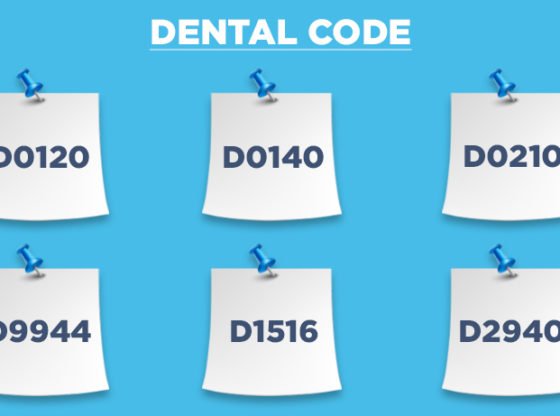
The common codes used are D0120 (Periodic Exam), D1110 (Adult Prophy), D1120 (Child Prophy), and D0210 (Full Mouth X-rays).
Detailed clinical notes, intraoral photographs, periodontal charting, and clear radiographic evidence.
Bill the wrong code, and you may get an instant claim denial, slow payment, or an audit of your practice altogether.
Recent updates have emphasized making the sleep apnea appliances more specific and refining the differences between various types of occlusal guard ADA code materials for 3D-printing technologies.
CDT codes are dentistry-specifically designed, whereas CPT codes are used in the case of medical procedures.
The insurance company can present a pre-estimation of the coverage based on the codes. With the help of the correct dental code of the night guard that you intend to apply, you can provide the patient with the precise out-of-pocket cost prior to commencing treatment.