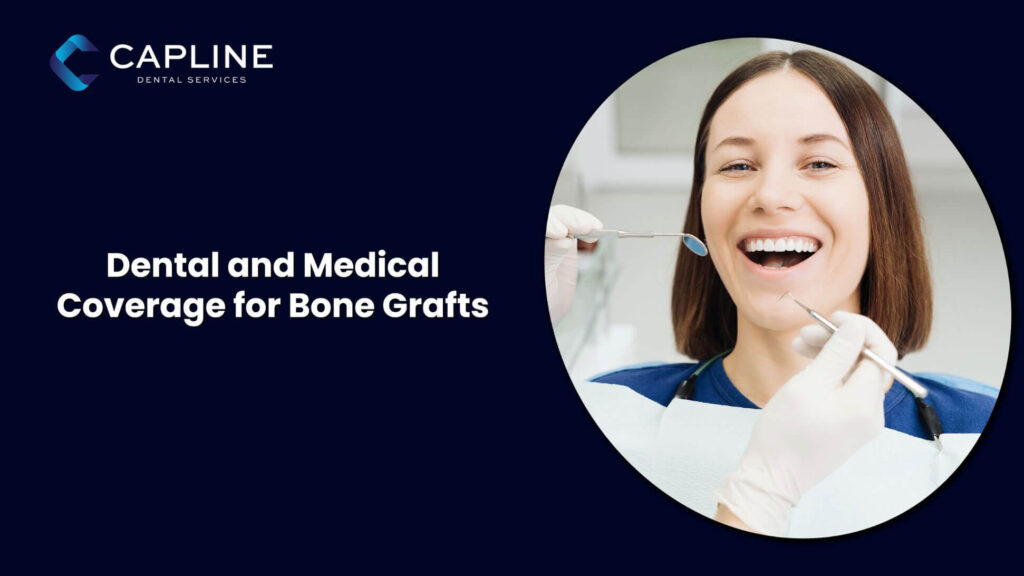
The financial side of bone grafting can be detrimental. Determining whether a bone graft is covered by insurance, with the assumption that there is cost-sharing. Treatments becoming expensive reflect the real-world scenario. One such is bone grafting, which helps reconstruct the jaw and prepare for implants. The procedure improves the gradual deterioration and provides additional support around the tooth.
At Capline Dental Services, we understand how confusing dental insurance can be, and several factors influence coverage in patients planning their treatments and managing costs.
The American Academy of Implant Dentistry reports that 500,000 dental implant procedures are performed yearly. 50% of these cases necessitate bone grafting. Having a market of over $2.7 billion. In dentistry, bone grafting is used to treat periodontal disease, while in medicine, it is used to treat fractures and bone loss caused by injury or trauma.
Bone grafting in the dental and medical fields falls into a gray area where both apply for the benefit of the patients.
Oral health is dependent on the health of the teeth and the surrounding areas. Gum disease can compromise the bone in the area, which affects the facial structure and the stability of the neighboring teeth. The dental implants are unachievable without additional support.
The procedure is directly related to dentistry, but its necessity can influence the role of medical insurance. It sounds simple, even though the coverage for bone grafting doesn’t feel the same.
Cleaning and fixing damaged teeth are covered by the plan. On the other hand, medical insurance focuses on the medically necessary surgeries that restore overall health conditions.
Bone grafting can be classified under either of the categories, depending on the reason that determines the reimbursement.
Bone grafting after the tooth extraction is the first scenario where dental insurance offsets the cost. A tooth is removed, and the socket is preserved for a dental implant through a bone graft. The insurer helps in cost-sharing.
The graft provided a basis for the gum disease. The bone graft receives coverage under surgery benefits.
Grafting plays a role in the stability of bridges or dentures. In this scenario, the plan partially participates in coverage for functional purposes. Cosmetics alone are not the reason for the plan to chip in.
Some insurance plans provide specifications about the techniques and the graft materials. For instance, a large ridge augmentation is covered at a lower rate than a graft for socket preservation. According to the survey conducted by the National Association of Dental Plans (2023), 15% of dental plans provide coverage for bone grafts associated with dental implants.
At Capline Dental Services, the team can work with timely preauthorization submissions to help in understanding which aspects of bone grafting are covered by the insurer.
With a specific scope in dental insurance, medical insurance can be a great help for bone graft coverage.
Bone loss caused by facial injury or accident requires reconstructive surgery rather than dental care by medical insurance.
Bone grafts correct the congenital condition that directly impacts physical function. For instance, cleft palate, birth defects, and jaw structure make a bone graft medically necessary.
The infection can destroy the bone structure and weaken the bone strength. For medical insurance, bone grafting is vital rather than optional.
Partial coverage is given for oral and maxillofacial surgery under surgical benefits, according to the Journal of Oral and Maxillofacial Surgery. The data show that 70 percent of jaw construction-related procedures are reimbursed by medical insurance.
Capline Dental Services, as a partner, can help with dental and medical insurance carriers whenever applicable. The statistical artifacts (2022) conducted by the American Dental Association found that 60 percent of patients are unsure whether insurance will cover their bone graft procedure.
Let’s have a look at the frequently asked questions on insurance and grafting.
Coverage for bone grafts differs greatly. A dental implant is an elective procedure, and therefore, it is subject to the insurer. If it is necessary for restoring bone structure, then it is partially covered.
Preauthorization determines the cost of the procedure to make decisions before the treatment begins.
The provider can submit an appeal with additional documentation for approval. Even though the insurance rejects the coverage, it doesn’t ignore the benefits that it currently provides to people with the insurance.
Assign a relevant ICD-10 diagnosis code along with CPT procedure codes for the medically necessary condition. Finally, complete the CMS-1500 medical claim form and supporting documents for approval.
To learn more about navigating insurance, schedule a consultation at Capline Dental Services to maximize patients’ benefits and accurate billing for the treatment.