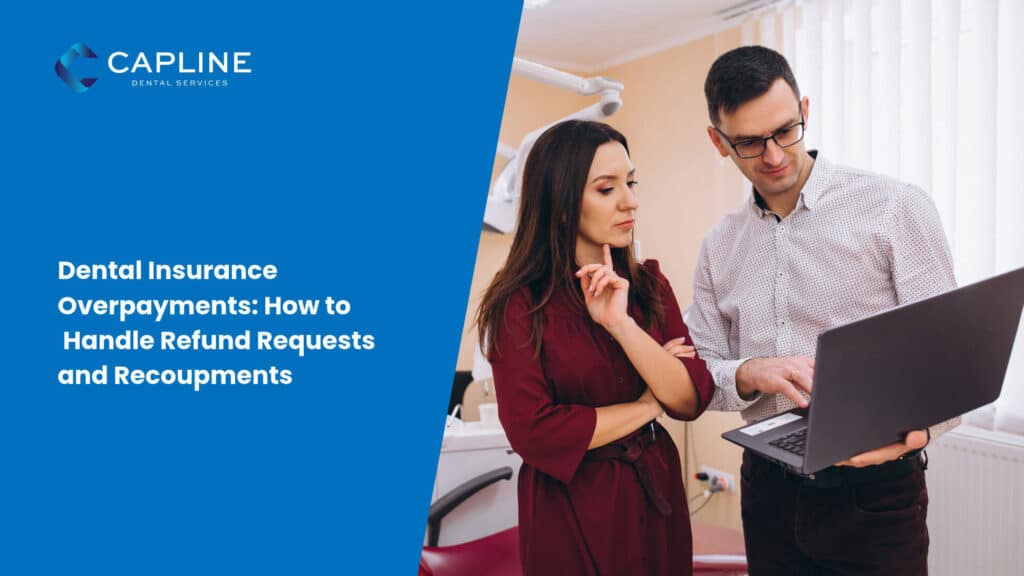
Sometimes a payer requests a refund of a dental insurance overpayment from a dental provider. Payers can recoup an overpayment up to two years after it occurs. By then, the patient may no longer be the dentist's patient.
Some payers, however, may recoup overpayments from other providers for the same patient by deducting them from future payments to the dentist.
What it is: A dental insurance overpayment refund is a credit balance when an insurance company asks for the money back.
Who it is for: Dental practices are charged a payment made by mistake. Whatever the reason, avoiding a refund request is not an option.
What to do: Capline Dental Services can work around insurance recoupments so that paid claims stay paid.
For example, an employer decides to terminate a group contract with a carrier and, without notifying the carrier, the employer stops remitting the premium. In these instances, there are state laws that require a grace period during which coverage cannot be terminated. During the grace period, carriers accept claims. They cannot tell the employer or member that coverage is not active. Ultimately, the patient is responsible for these claims. Grace periods expire, and if the employer notifies the carrier that it is terminating coverage or changing carriers, state law requires the termination to be effective from the date of the last premium payment.
Consequently, claims paid during the grace period are void. The same applies to coverage during the grace period.
The new carrier is accountable after a group change. Patients will be held liable for any claims paid during the benefit change.
Refund requests also apply when claims are submitted with incorrect provider names. For example, a provider or dentist may be in-network, but if a claim is submitted with a generic practice name, it may be paid out-of-network. This has happened in multiple carrier reconciliations; the carrier will reprocess the claim with the benefit and explain to the customer that it was paid incorrectly.
Another common scenario in which refund requests are made is when an incorrect code is used to describe the service provided. An overpayment may occur as a result of the payer not having any knowledge or control over the service provided.
In cases regarding a patient’s transfer to a different dental office, the payer will ask the dentist for the correct CDT code to describe the service provided. The claim will then be reprocessed, and a verpayment request will be sent to the first dentist.
Codes are submitted beforehand, such as for a crown, and if the patient never returns to complete the service. The payer may request a refund. If the patient did not return to receive the final service, they would also be responsible for the cost of lab and office work.
37 million people have an employer-sponsored dental plan from 170 million U.S. citizens.
For these contracts, the payer ensures benefits comply with the contract. These self-funded employers, with the expectation of a refund, closely examine overpayments. Most payers will issue a refund before taking an administrative deduction from the next payment.
There is no statute of limitations for refund requests; however, payers will request a refund as soon as an overpayment is identified. Requests for refunds are defined within the provider network agreements. Plans are prohibited from automatically taking a deduction from a subsequent payment for services provided by non-contracted providers.
Capline, with a team of experts, can guide practices through dental insurance overpayment refunds without stressing daily operations:
These solutions empower practices to ensure accurate billing with better visibility. The focus is stress-free care. Whether to use RCM billing services is a choice, but you can be sure you'll get more accurate billing. Book a consultation today to get started.
A request for a refund for a claim already paid can happen due to: