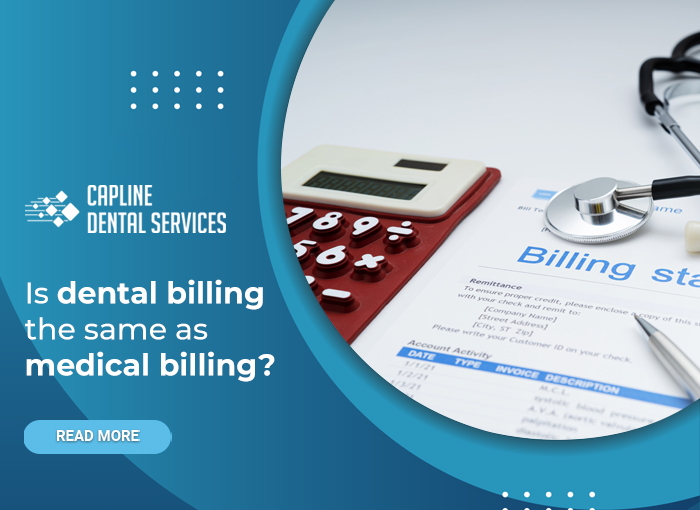
The importance of a dental practice that wants to maximize revenue cycle management (RCM) is to understand the details of dental vs medical billing. Although both disciplines imply filing claims with insurance companies, the two differ greatly in terms of procedures, codes, and policies. The following blog will examine the major differences, intersections, and best practices that can be used to assist dental practices in making their way through billing.
Dental billing refers to the process of making claims of dental practices to insurance companies or the patients so that they can be paid. It needs special knowledge in dental coding systems, including the Current Dental Terminology (CDT) codes, to record the correct services, including cleanings, fillings, or orthodontics. Efficient dental billing is the guarantee of timely payments and reduced claim reimbursement, which directly affects the financial well-being of a practice.
Medical billing involves the medical claims filed to the insurer for the expected reimbursement, considering the treatment offered by the provider. Similarly, dental billing encompasses every aspect of getting reimbursement from the insurance provider as per the patient's insurance plan.
However, there are many steps in the dental billing process, and if one of the steps gets missed can result in delayed payment from the insurance carrier.
The billing process in dental work has a number of procedures to follow to have the right claims and payments:
In complex cases, medical billing of dentists can be required, and some extra procedures, such as medical billing authorization, are required.
The dental and medical billing processes are quite similar in nature. Both involve submitting claims for reimbursement of healthcare services. The main difference lies in the type of service billed, software used, etc. We have shared a table below stating the clear differences between the two.
The difference between dental billing and medical billing lies here:
| Aspect | Dental Billing | Medical Billing |
| Primary Coding System | CDT codes (e.g., D0150 for comprehensive oral evaluation) | CPT and ICD-10 codes (e.g., 99213 for office visit, E11 for Type 2 diabetes) |
| Insurance Type | Primarily dental insurance plans (e.g., Delta Dental, MetLife) | Medical insurance plans (e.g., Blue Cross, Medicare) |
| Claim Submission | Often simpler, with fewer pre-authorizations | Requires detailed documentation and frequent pre-authorizations |
| Procedure Focus | Oral health (e.g., cleanings, fillings, crowns) | Broader healthcare (e.g., surgeries, diagnostics, chronic disease management) |
| Regulatory Compliance | HIPAA, with dental-specific privacy considerations | HIPAA, with stricter medical record and billing regulations |
| Reimbursement Timeline | Typically faster due to simpler claims | Often slower due to complex claims and payer scrutiny |
| Common Software | Dental-specific (e.g., Dentrix, Eaglesoft) | Medical-focused (e.g., Epic, Kareo) |
Medical dental billing is done when dental treatment is needed for a medical necessity, like the reconstruction after an accident or for TMJ disorders. Dental practices can charge medical insurance with the help of CPT and ICD-10 codes in such situations. Key overlaps include:
To be acquainted with such overlaps would help a practice bill for medical insurance and dental procedures, where needed.
This proposal of medical billing for dentists has several advantages:
Staff in dental practices should be trained in medical coding to utilize such benefits.
Claims may be denied and lost due to billing errors. Common mistakes include:
Such errors can be countered by bringing regular audits and training of the staff.
Dental vs medical billing also has problems, among which are:
In the case of dental practices, collaborating with a dental insurance billing and collection service may help simplify the operations and minimize mistakes.
In order to maximize dental RCM, it is possible to take into account the following best practices:
No, dental billing and medical billing are not the same. Although both imply filing claims with insurers, dental billing concerns oral health services based on the use of CDT codes, whereas the scope of medical billing is extended and includes a wider selection of healthcare services based on CPT and ICD-10 codes.
The distinction between the dental billing and medical billing is in their coding systems, type of insurance, and regulations, and as such, the dental practices require a specifically designed dental RCM. Dealing with the dental vs medical billing involves the knowledge of their processes, coding systems, and issues.
Dental billing can be defined as the process of filing dental procedure (cleaning or extracting) dental claims with insurance companies or patients via CDT codes. It also secures the timely payment of practices of services provided.
Some of the challenges are coding mistakes, refusals of claims, and patient conflicts. The solutions include dental-specific software and training of the staff, and outsourcing to professionals for dental insurance billing and collection services.
A medical biller can also be referred to as a medical coding specialist, healthcare reimbursement specialist, or billing coordinator.
CDT code is used in dental billing, but CPT and ICD-10 codes are used in medical billing. Both must be accurate so as not to deny claims.
Dentrix or Eaglesoft software is used in dental practices, whereas Epic or Kareo is commonly used in medical billing. Both use electronic health records (EHRs) to facilitate claims processing.
Patient data under HIPAA is required to be secured in both fields. Medical billing is broader-based health information compared to dental billing, which is based on an oral health record, and thus, more documentation is needed.
Outsourcing will cut back on mistakes, save time, and enhance the cash flow through professional expertise in dental RCM, as staff will concentrate on patients.