
It is a common scenario that a brilliant clinical staff is offering the highest level of care in the world, and the back office is overwhelmed with an ocean of "Pending" and "Denied" statuses. Understanding the nuances of dental insurance claims isn't just an administrative chore. It is the lifeblood of your practice's cash flow.
The intricacy of the U.S. reimbursement environment is probably among the largest points of stress, regardless of whether you are a single practitioner or you operate in a multi-location group.
In this guide, we shall remove the jargon and examine the very principle of why and how the billing cycle works. You will know how to work around the lifecycle of a claim, the silent killers of your revenue stream, and a workflow that will allow you to get paid for the work you do. So, let’s start.
We should first work out the plan before the claim. The majority of U.S. practices address three categories:
The procedure begins at the front desk, not the computer, to learn how to claim dental insurance.
Dental insurance claims follow a multi-step process lifecycle. Let’s understand.
Everything starts here. You should always check the insurance at least 48 hours before the appointment, which is recommended by almost every practice. You will need to verify the rest of the annual maximum, deductible status, and whether the particular procedure (such as a crown or a bridge) has a frequency limitation or a waiting period.
After the process, it is the responsibility of the clinician to record it correctly. The quickest method to receive a rejection is to use a CDT code that is old. As an example, when you are making orthodontic insurance claims, you have to state whether this is interceptive or comprehensive treatment.
It is also supposed to go through a scrubber before the claim is received by the payer. This software verifies the absence of an NPI number, invalid birthdates, or subscriber ID mismatch. This is the first line of defense.
This is the black box where the insurance carrier makes decisions as to whether to pay. They match the offered claim with that of the patient’s policy. In case it all comes out even, then the claim is approved.
The carrier provides an Explanation of Benefits (EOB) or an Electronic Remittance Advice (ERA) and payment. This should be reconciled in your Practice Management Software (PMS) so that the balance of the patient is updated.
As a healthy US practitioner, you should have a claims rate of 95% or more. A 2024 Revenue Cycle Report lists the industry-wide figure to be 75-80% on average. This is to say that 20% of your work is administrative. When your accounts receivable (AR) over 90 days is greater than 10 percent of your total AR, then your success ratio needs to be addressed.
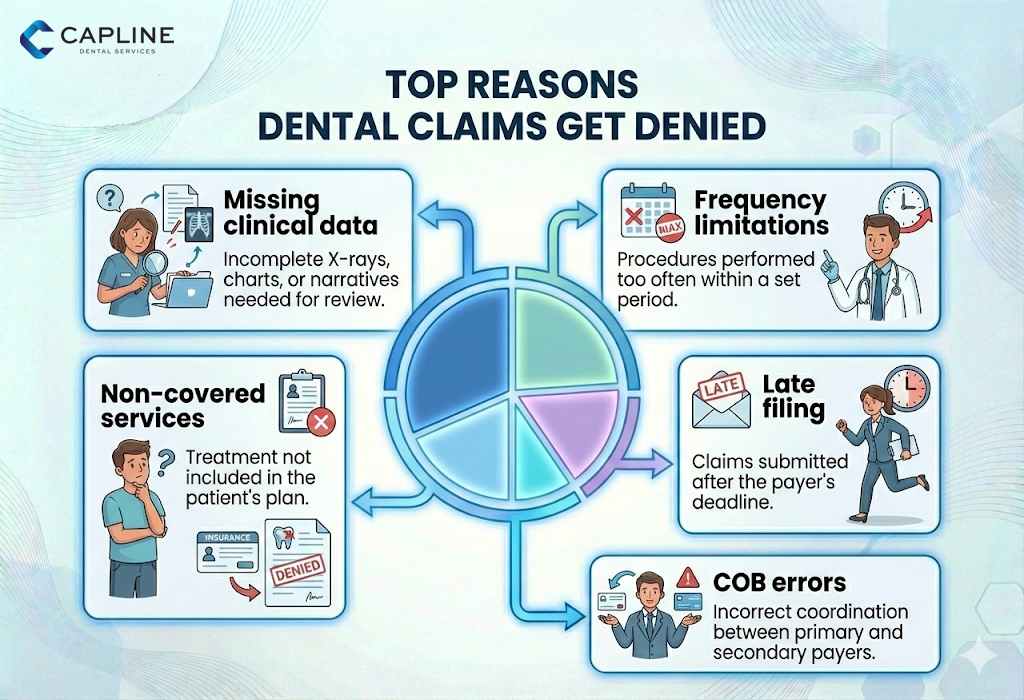
Preventing denials is significantly cheaper than appealing them. Let’s understand.
Insurance adjusters usually are not clinicians; they use a checklist. When filing a claim on a core buildup (D2950), do not simply send an X-ray. Include a narrative that says, "Existing restoration failed with recurrent decay; less than 50% of sound tooth structure remains." This particular language is that of the payer.
As we talk about experience, an intraoral photo is equivalent to ten X-rays. In the case of a cracked tooth syndrome or large amalgams that have marginal breakdown, the specific photo will be the visual evidence required to approve a crown in certain cases.
The American Dental Association (ADA) revises CDT codes on a yearly basis. When your team works with the codes of 2022, you are requesting a rejection. Direct review of changes to codes: Have a Lunch and Learn once a year, in January.
Problem: Patients who are angry with unforeseen bills.
Hint: You should always give a signed treatise of financial agreement before treatment is given on a pre-estimate.
Problem: Secondary insurance is taking forever.
Hint: You should attach the primary EOB with the secondary claim filing so that you do not encounter a delay of request of information.
Problem: Claims are getting lost in the mail.
Hint: Switch to 100% electronic claims with real-time tracking.
Learning dental insurance claims is what makes the difference between a surviving practice and a flourishing practice. The aspect of clean data entry, proactive clinical narratives, and follow-up will help you greatly reduce your denial rates.
Our specialists at Capline can assist your practice in recapturing their time and revenue. So, contact us now.
Dental insurance claims involve submitting details of services rendered, using CDT codes on ADA forms, to the insurer for reimbursement.
Unlike standard dental insurance claims for routine care, dental negligence payouts address malpractice, such as botched procedures causing injury.
Cosmetic procedures like teeth whitening or veneers for aesthetic reasons are typically not covered.
Most dental insurance claims are processed in 15-45 days for electronic submissions, though complex ones like orthodontic insurance claims may take up to 60 days.
Verify full name, date of birth, insurance ID, group number, and coverage effective dates. Also, check for secondary insurance, deductibles, and exclusions to ensure accurate filing and prevent denials.
Co-pays are fixed amounts patients pay per service (e.g., $20 for a cleaning), while deductibles are annual out-of-pocket thresholds (often $50-100) met before insurance covers portions.
If coverage lapses mid-treatment, the practice may bill the patient directly for remaining services.
Delays often stem from missing documentation, insurer backlogs, or appeals for denials. Incomplete ADA forms or disputes over medical necessity can extend processing beyond the standard 45 days.
Bill secondary carriers after the primary insurer processes the claim and issues an EOB.