
Claims get denied for small reasons. One of the most common is missing context. The service may be correct, but the payer still needs a short “flag” that explains what is special about the billing situation. That is where condition codes help.
In this blog, you will learn the condition code meaning in medical billing, where they go on an institutional claim, how to pick the right one, and how Medicare and other payers use them during claim review.
A condition code is a two-character code used on an institutional claim to describe a situation that can affect how the claim is processed. In plain words, it tells the payer, “this claim has a special condition you should know about.” CMS describes condition codes as situational codes used to describe conditions or events that apply to the billing period.
You will usually see these entered on the UB04 claim in the condition code boxes. These are commonly called ub04 condition codes.
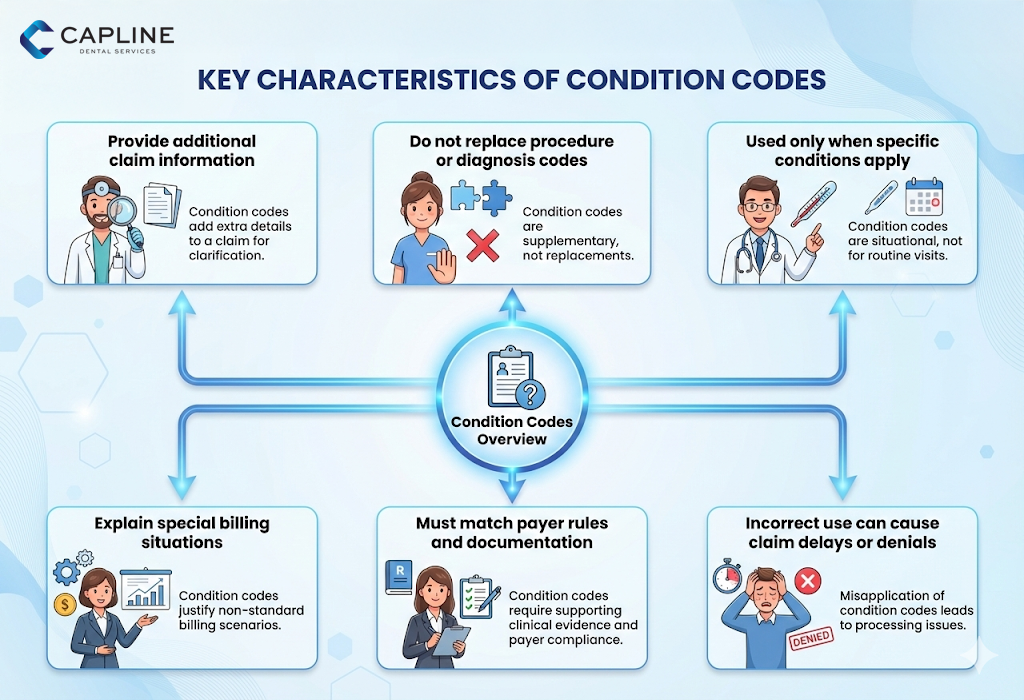
Here is what makes condition codes different from many other claim fields:
Think of condition codes as claim “signals.” They can:
This is why the condition code meaning in medical billing matters. It is not just data entry. It is part of claim logic. CMS explains that these codes describe conditions or events that may affect claim processing.
A lot of people ask for a full list of condition codes, but the official complete list is maintained in the official UB04 data resources and is licensed. Still, it helps to know a few common examples so you understand how they work. Here are examples you will see referenced in billing guides and payer instructions:
Information only billing: Some condition codes are used when the claim is submitted for information or a special billing purpose. Payer guides often describe these as “information only” situations, depending on the payer and bill type.
Inpatient changed to outpatient: A common use case is when an inpatient admission is later changed to outpatient billing, based on rules and medical review. Many billing guides reference condition codes used for this kind of scenario.
Delayed filing or special liability situation: Medicare contractors publish lists and explanations for condition codes used in specific claim submission scenarios, such as delayed filing indicators and other special claim circumstances.
Important note: Do not copy a code just because you saw it online. Always confirm the exact code definition and payer rule for your claim type and date of service. CMS points providers to the NUBC resources and contractor guidance for the correct codes.
Many people use the phrase medicare condition codes to mean “condition codes Medicare recognizes and edits against.”
Medicare uses the national UB04-style condition code set, and it also publishes instructions and claim edits through manuals, transmittals, and contractor guidance. CMS notes that codes used for Medicare claims are available from Medicare contractors and through the NUBC UB04 data resources.
CMS has also implemented newly created NUBC condition codes when needed. For example, CMS issued guidance about implementing a new NUBC condition code “KX” for “documentation on file” to support medical policy requirements. The takeaway is simple: medicare condition codes are not just “nice to have.” Medicare and its contractors may require specific condition codes in specific situations, and claim edits can depend on them.
The condition code set used on institutional claims is part of the UB04 data specifications maintained through the National Uniform Billing Committee process. NUBC provides access to the official UB04 data file that contains the code lists. Also, the condition code system is recognized as an AHA and NUBC related code system in industry references, and the official UB04 manual is treated as the main source for UB04 billing specifications. If you are wondering what the “latest manual” is, NUBC notes that the current UB04 manual edition is the 2026 edition, and it follows an annual subscription cycle.
Condition codes are small, but they carry a lot of weight in claim processing. They explain special billing situations that a payer cannot easily infer from the rest of the claim. When your ub04 condition codes match your documentation and the rest of the claim, you reduce avoidable denials and delays.
If you need a quick rule to follow, use this one: only report a condition code when it truly applies, and make sure the chart, dates, and claim fields support it. For the official code definitions and current updates, rely on CMS guidance and the current NUBC UB04 resources.
To learn more about medical billing, connect with our experts at Capline Dental Services. We’re here to help you. Contact us today.
Condition codes describe conditions or events that apply to the billing period and may affect processing. Occurrence codes report specific events and dates. CMS describes condition codes in the condition code fields and separately describes occurrence codes and dates in their own fields.
There is no single “most common” set because it depends on provider type and payer rules. Medicare contractors publish commonly used codes for their claim scenarios, and the complete list of condition codes is maintained in the official UB04 data resources.
Condition codes explain a billing situation. Occurrence codes report an event with a date. On UB04, they live in different fields and serve different purposes in payer edits.
Payers typically check that the code is valid for the claim type and date of service, and that it matches other claim fields and documentation. Medicare also relies on contractor instructions and CMS manuals for how condition codes affect processing.
Updates can include new codes, revised code descriptions, or guidance changes in the UB04 data set. NUBC confirms the current manual cycle and edition timing, and CMS may issue implementation instructions when a new condition code is added and adopted for claims.