You have probably wasted many hours on the phone with insurance adjusters or speaking with confused patients over the complicated breakdown of the benefits as a dental practice owner or office manager.
The DHMO vs. PPO argument is one of the most prevalent sources of disagreement in the front office. The patients tend to select a plan that has the lowest monthly premium without being aware of how it affects their provider selection and out-of-pocket costs. In healthcare practices, it is important to be aware of these nuances in order to treat patients effectively and have a successful revenue cycle management.
In this guide, we will understand the basic distinctions between these two dominant models of insurance. You may be assisting a patient in navigating their Cigna DHMO plan or explaining to a patient why their DPPO has an annual maximum. This article will give you the technical understanding that you require to help patients.
Dental insurance can simply be described as a contract between an insurance company and an individual (or employer) to cover the oral healthcare expenses. Dental insurance is more of a wellness and maintenance program as opposed to medical insurance, which, in most cases, tends to emphasize major coverage. It encourages regular utilization to prevent high-cost emergency interventions later.
For dental practices, one of the major motivators of patient volume is insurance. The National Association of Dental Plans (NADP) 2025 Enrollment Report states that there is likely an 83 percent coverage of the US population with a dental benefit of some kind. Covered patients are almost twice as apt to go to the dentist to get a preventive check-up, which is the foundation of your hygiene department and lifetime restorative pipeline.
Let’s discuss three major types of plans that are overtaking the US market:
To ensure that the claim denials are minimal and that patient satisfaction is maximized, any practice will need to understand the technical mechanics of DHMO vs PPO. The difference goes way beyond the price of the premium; they determine the whole process of a patient from the initial phone call to the final payment.
The most apparent difference is between the DHMO network and the PPO network. In a Dental Health Maintenance Organization, the patient is very much restricted to a network of providers. In case they are taken care of outside this network (except emergencies), the insurance company usually pays nothing. Moreover, in most DHMOs, the patient is supposed to be assigned to a primary care dentist (PCD).
On the other hand, a comparison of DPPO vs DHMO also shows that PPO plans are quite flexible. Any of the licensed dentists can see the patients. Although they would enjoy the greatest benefits as they remain in-network, they retain out-of-network benefits that would provide them with the opportunity to visit the provider of their choice, notwithstanding the fact that the provider is not in the plan's fee schedule.
For specialists, the DHMO dental meaning is synonymous with "referrals." When a DHMO patient requires an endodontist to have a complicated root canal, he/she cannot make an appointment just like that. Their assigned primary dentist should make a formal referral to the insurance company. In a PPO system, the referral process is less strict (or absent), and the specialized care can be obtained faster.
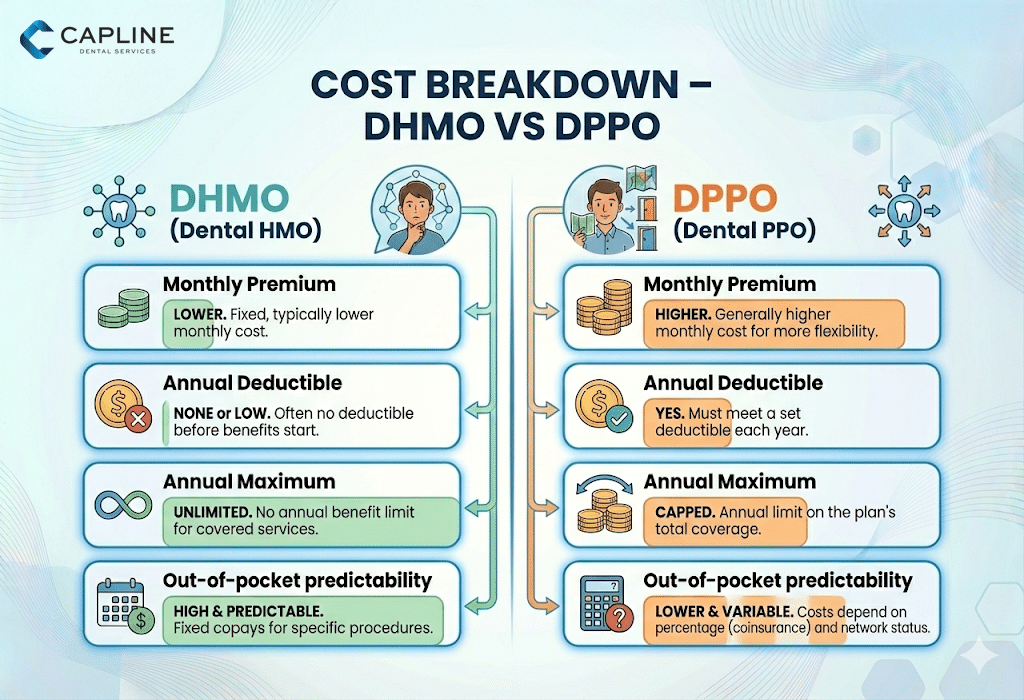
Financial structures vary wildly between the two:
| Feature | Dental HMO (DHMO) | Dental PPO (DPPO) |
| Provider Choice | Limited to the assigned in-network dentist | Any licensed dentist (In or out of network) |
| Monthly Premium | Significantly lower ($15–$35 avg) | Higher ($35–$60+ avg) |
| Annual Deductible | Usually $0 | Typically $50 per person |
| Annual Maximum | Usually None | $1,000–$2,500 average |
| Referrals | Required for specialists | Usually not required |
| Claims Process | Fixed copayments at the office | Coinsurance (percentage-based) |
Is DHMO or PPO better? It depends on the procedures needed by patients. These two plans differ with regard to their coverage needs.
The two plans typically pay 100% of preventive care, including examinations, cleanings, and simple X-rays. Yet, DHMO dental insurance might impose more rigid frequency restrictions (e.g., only two cleanings a year) than a PPO with its flexible policy.
This is where the DHMO dental model proves to be cost-effective for a cost-conscious patient. DHMOs have a copayment schedule. As an example, a patient may have a mandatory copay of $250 on a crown, irrespective of the charge made by the dentist. Patients with a limited budget greatly appreciate this predictability.
In a PPO, services are covered via coinsurance. A standard "100-80-50" plan pays:
PPO plans are often provided with orthodontic riders to children, but not to adults. DHMOs, such as the Cigna DHMO or DeltaCare USA, usually have an adult orthodontic benefit at a very reduced flat rate and are not popular with families planning to get braces.
The best plan that a practice has to use is the one that enables you to give the best care without administrative gridlock.
Navigating the complexities of DHMO vs PPO is a daily reality for modern US dental practices. In case you are also confused and need help, then you are at the right place. At Capline, we offer dentists extensive dental billing support. So contact us today!
PPO stands for Preferred Provider Organization, allowing patients to choose from a network of dentists for discounted rates or visit out-of-network with reduced coverage.
HMO, or Health Maintenance Organization, requires selecting a primary dentist from a limited network, emphasizing coordinated, cost-effective care.
Deductibles are the amount patients pay out-of-pocket before insurance kicks in, common in PPOs but rare in DHMOs.
In a PPO, coinsurance might mean the plan covers 80% of a filling, leaving the patient with 20%. DHMOs use fixed copays instead, like $25 flat.
DHMO pros: low costs and no deductibles. Cons: limited choice. PPO pros: Flexibility, out-of-network options; cons: Higher premiums, maximums.
DHMO premiums are typically 20-40% lower due to restricted networks, while PPOs cost more for added freedom.
In DHMOs, it's usually not covered at all. In PPOs, reimbursement drops (e.g., 50%), and patients face balance billing.
Preventive care, like cleanings and exams, is often 100% in both, with DHMOs extending this via low copays.
DHMOs cap via copays without annual limits; PPOs use maximums ($1,000-$2,000) and waiting periods for majors like crowns.