
Among the most common areas of friction in US dental practice are not the clinical practices but the discussion that follows at the front desk.
We have experienced that when a patient receives a high out-of-pocket payment, they think a specific treatment was a routine one, whereas the insurance company considers it a major procedure. To the providers, dealing with the choice of basic vs major dental services is not merely a semantic issue but the pillar of proper billing, revenue cycle, and retaining patients.
In this guide, we will break down the clinical and administrative boundaries between these service tiers. You will get to know the standard industry classifications, whether you are polishing your internal coding protocols or trying to educate yourself better on how to educate your patients on their coverage. So, let’s discuss.
The middle ground of treatments in the hierarchy of dental billing is called basic dental services (also known as basic dental care). They are processes that are neither as simple as dental preventative services (such as cleanings and examinations) nor yet as complex as reconstructive services.
Basic services are usually restorative in nature but have comparatively lower costs of laboratories and less time in clinical chairs. For most PPO plans, these are covered at a higher percentage than major work, often around 80%. The most common error in high-volume practices is misclassifying a complex restorative case as a basic service, leading to unexpected patient balances.
Major dental care involves multi-stage procedures that are complicated and are aimed at restoring or replacing missing or severely damaged teeth. These services require a considerable amount of labor in the laboratory, costly materials, and considerable clinical experience. Since these treatments are costly to the insurers, they tend to have the least percentage of coverage (usually 50) and are accompanied by waiting periods.
Talking about major services, we are considering the long-term structural health of the oral health of the patient. Since these procedures are a huge investment of money for the patient, the treatment planning on their part is critical.
Understanding the clinical "line in the sand" between these two categories is vital for practice efficiency. Although each insurance carrier has its proprietary language of contracts, the industry tends to have a general breakdown.
The most noticeable distinction in the clinical practice is the usage of an external dental laboratory.
Simple dental practices are usually classified as restorative patching or correcting a common dental problem. Major services, on the other hand, are reconstructive. You have now crossed over into the "major" category, in case you are replacing over half of the tooth structure or replacing a tooth entirely (dental implants or bridges).
On the management side, the overhead of major services is much greater. The lab charges and the time to add to your chair time, preparing and delivering, have made your profit margins on major services thinner unless your billing department is keying in the right code.
Pro Tip: Make sure your billing department is current on your Medicaid legacy number and your NPI credentials to make sure that no matter the level of service, the provider will be identified correctly in the clearinghouse. This is more crucial in multi-provider practices that deal with both minor and major cases.
Patients tend to see basic as “having low cost” and major as “having no necessity or as a luxury.” This is what you have to fill in as a doctor. Communicating that one requires a major crown to save a basic root canal is a fundamental skill that leads to acceptance of cases.
These distinctions must be clearly reflected in your dental billing workflows to avoid downcoding or denials.
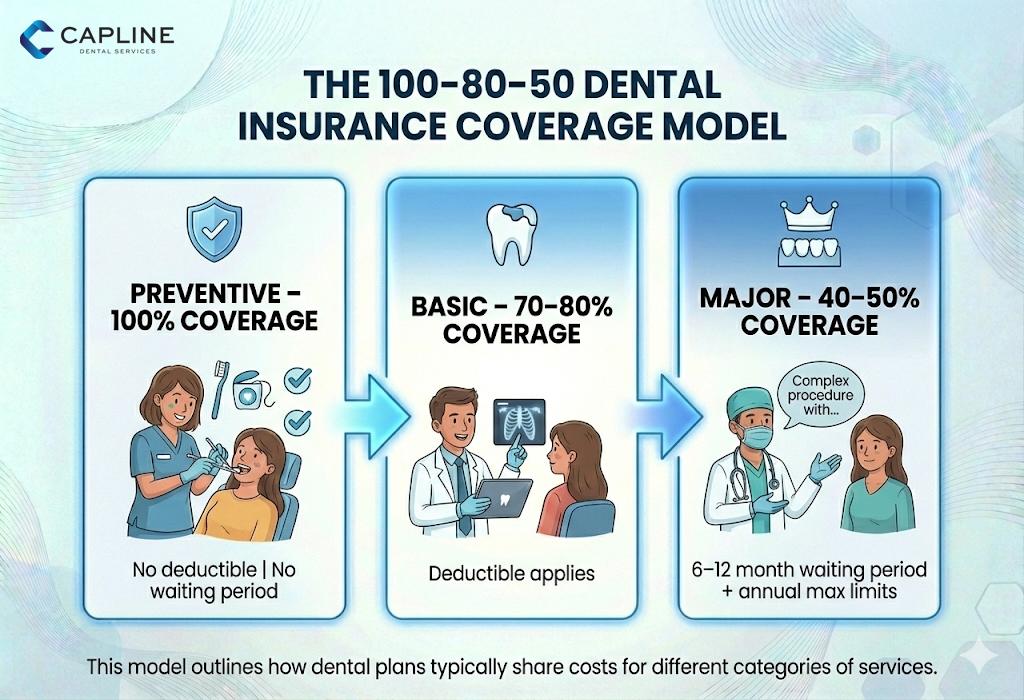
The traditional formula of 100-80-50 is the typical structure of most of the US dental insurance programs, but we are witnessing newer variations in recent years.
It is notable that the orthodontic services nearly always occupy a separate category. They rarely fall under the basic or major umbrellas and usually have a separate lifetime maximum benefit. In case your practice does provide Invisalign or traditional braces, make sure that your staff is not combining them with major dental care in the pre-authorization verification process.
While fees vary significantly by zip code and specialist status, having a baseline helps in treatment planning.
| Service Category | Typical Procedure | Estimated Fee Range (US) |
| Basic | Simple Extraction | $150 – $400 |
| Basic | Composite Filling (2 Surfaces) | $200 – $450 |
| Major | Porcelain/Ceramic Crown | $1,100 – $2,000 |
| Major | Complete Denture (Per Arch) | $1,500 – $3,500 |
To make your front-office training easier, we would group basic dental services under these standard buckets:
One of the most important skills that a healthcare practice with its location in the US could have is differentiating between basic and major dental services. Knowing the clinical complexity, lab needs, and insurance coverage tiers (100/80/50), you will be able to make more precise estimates and lessen the administrative load on your team.
At Capline, we specialize in helping practices streamline their billing and coding to ensure you are reimbursed fairly for the high level of care you provide. We will assist you in developing your billing department as a practice growth source.
Dental services are categorized into preventive (cleanings, exams), basic (fillings, extractions), and major (crowns, implants). These tiers guide insurance coverage and practice focus. Preventive emphasizes avoidance, while basic and major handle restoration.
Comprehensive dental services encompass all aspects of oral care, from preventive and basic to major and cosmetic, provided in one location for holistic treatment. This includes exams, restorations, and specialized procedures like orthodontics.
Major dental care often has 6-12 month waiting periods, with limitations like annual maximums and 50% coverage. Plans may exclude certain procedures or enforce "least expensive alternative" rules.
PPO plans offer a wide range of basic and 50% for major, with out-of-network flexibility but higher premiums. HMO plans provide fixed copays for both but restrict them to in-network providers, with no out-of-network for majors.